
(719) 210-8699

Your Insurance Company May Have Already Inspected Your Roof Without Telling You

04/16/2026

Insurance drone roof inspection Colorado Springs homeowner

Published by Gerald Winik| Colorado Springs Roof Consultants


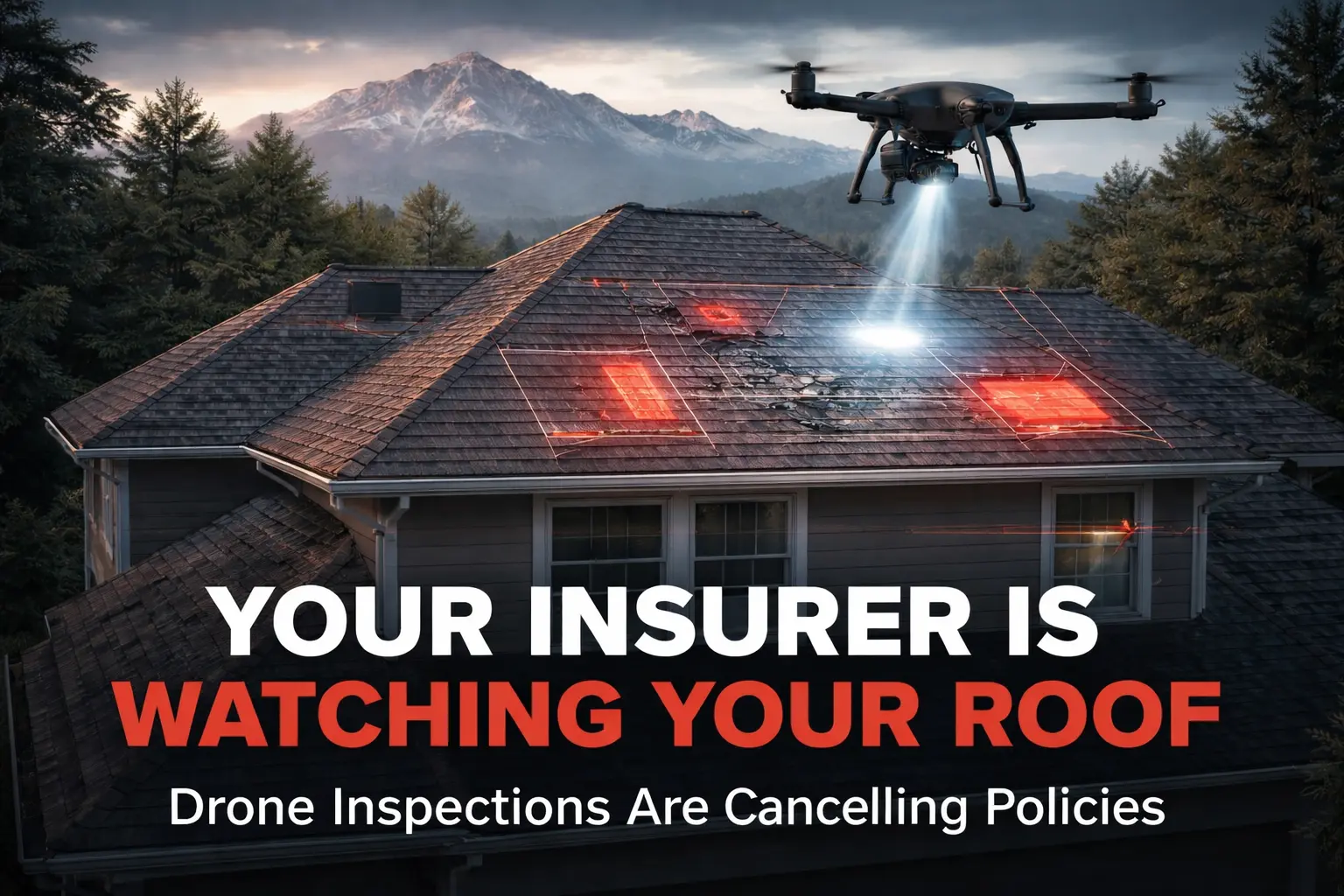
If you haven’t filed a claim, haven’t missed a payment, and haven’t heard a word from your insurance company — you might still be weeks away from losing your homeowner’s coverage. Not because of anything you did. Because a drone or satellite quietly flew over your house, an AI analyzed the images, and an algorithm decided your roof was a liability.

This is happening to homeowners across the country right now, and Colorado Springs is ground zero for it.


What’s Actually Going On

Insurance companies have been sending human inspectors to properties for decades. That model is expensive, slow, and occasionally dangerous — inspectors climbing steep roofs in all weather. So over the past several years, carriers have shifted to a different approach: aerial imaging from drones, satellites, and manned aircraft, paired with AI software that analyzes the footage and flags potential problems.

The companies doing this work — firms like CAPE Analytics and Nearmap — claim coverage on roughly 99% of the U.S. population. That means the imagery almost certainly exists for your home. Whether your insurer has looked at it is a separate question. Whether they’ve acted on it without telling you is the one that matters.

The process typically works like this: at policy renewal time, your insurer reviews aerial imagery of your property. If the AI flags a problem — moss, lifted shingles, overhanging trees, debris, granule loss — you receive a notice. Sometimes that notice gives you time to fix things. Sometimes it’s a non-renewal letter with a deadline. And in most states, including Colorado, carriers are not required to show you the images they used or explain exactly how the AI reached its conclusions.


The Roof Age Threshold Has Moved

Here’s something Colorado Springs homeowners need to understand: the age at which a roof becomes a problem for insurers has dropped significantly over the past few years.

For a long time, the rough benchmark was 20 years. If your roof was under 20, most carriers weren’t concerned about age alone. That line has moved. Many carriers have now pushed it to 15 years, and in Colorado’s hail-prone Front Range market, some insurers apply a 10-year threshold, particularly for asphalt shingles. At that point, coverage shifts from replacement cost value (RCV) — where the insurer pays to replace your damaged roof with a new one — to actual cash value (ACV), where they factor in depreciation and pay out a fraction of that.

The practical effect is significant. A 15-year-old roof with a $20,000 replacement cost might generate only $5,000 in coverage under ACV, leaving you responsible for 70 to 75 percent out of pocket. For homeowners in Colorado Springs — where hail-related claims account for 55 to 70 percent of homeowners insurance costs statewide — that distinction is the difference between a manageable storm and a financial crisis.


Real Cases: When the System Gets It Wrong

The broader practice of remote aerial inspection is defensible in principle. The problem is the AI gets it wrong. Regularly.

The California Solar Panel Case

Janice and Anthony Coleman had been Liberty Mutual customers for 20 years. No claims. Paid on time. In 2024, they received a non-renewal notice. The reason: satellite imagery supposedly showed algae, mildew, and moss on their roof. The Colemans reviewed the image. The three dark rectangular shapes the AI had flagged as moss were their solar panels. Liberty Mutual refused to reverse the decision even after the Colemans hired a professional roofer who confirmed the roof was in good condition.

The Wrong House Entirely

In Texas, at least one documented case exists where an insurer used aerial images of the completely wrong house to justify a non-renewal. The policy was only reinstated after the Texas Department of Insurance got involved.

Five-Year-Old Roof, Full Replacement Demanded

Also in Texas, a homeowner outside Houston received notice that she needed a full roof replacement to keep her coverage. Her roof was five years old and in good condition. She asked to see the aerial images the insurer had used. The company declined to provide them. She had, in her words, “no recourse as a homeowner. None whatsoever.”

The Massachusetts Tree Branch Situation

Lynne Schueler of Topsfield, Massachusetts had no idea her insurance company had been over her house until she got an email. A drone had photographed overhanging tree branches, and she was given six weeks to remove them or lose her coverage. She wasn’t home when it happened — the car wasn’t in the driveway. Tree removal cost her $1,200. She paid it because she had no other option.


Is It Legal for an Insurance Company to Fly a Drone Over Your Property?

This is the question most homeowners ask first, and the answer is more complicated than you’d expect.

In most cases, yes — it is legal, and here’s why.

Under federal law, the FAA has jurisdiction over navigable airspace, and the Supreme Court has established that property owners don’t have exclusive rights to the airspace above a certain height. Anything visible from that airspace carries no reasonable expectation of privacy under current legal standards. Insurance companies also argue — with some justification — that your policy contract gives them the right to inspect the property they’re insuring.

That said, the legal picture in Colorado has some nuance worth knowing. Colorado Revised Statute 41-1-107 gives surface landowners airspace rights above their property, creating a potential basis for civil trespass claims involving low-altitude drone flights. Legal scholars note this statute hasn’t been extensively litigated, but it does exist and it’s specific to Colorado. Low-altitude overflights — below what courts have defined as navigable airspace — sit in a legal gray zone that courts are still working through.

What’s also worth knowing: many insurance companies don’t fly drones directly at all. They contract third-party aerial imaging firms that have already captured and catalogued imagery of virtually every residential property in the country. State Farm, for example, told Texas regulators it doesn’t operate drones but contracts companies that do. The legal distinction matters for liability purposes. For practical purposes, the result is the same: your roof gets inspected, and you don’t find out until a letter arrives.

The short version: in most states, insurance companies can currently do this. But states are starting to push back. California introduced legislation in 2025 requiring insurers to notify homeowners before using aerial data in coverage decisions. Massachusetts has a proposed bill that would give homeowners the right to see the images and have a formal appeals process. Michigan’s Department of Insurance issued a bulletin in 2025 specifically requiring insurers to share aerial images with homeowners before taking adverse action, and ruling that cosmetic issues like algae staining cannot be grounds for cancellation. Colorado has not enacted similar protections as of this writing, which puts the burden squarely on homeowners to protect themselves.


What Colorado Springs Homeowners Are Dealing With Specifically

Colorado Springs sits in what meteorologists call “Hail Alley.” The frequency and severity of hail events here is among the highest in the country, and insurers have priced their risk accordingly — and then some.

Colorado holds the fourth-highest average homeowners premium in the country, running roughly $4,600 per year on average, with costs climbing higher in areas that combine hail and wildfire exposure. That pressure has driven carriers to tighten underwriting standards, and the roof is almost always the first thing they look at.

For context: hail-related claims represent a massive share of Colorado’s homeowners insurance losses. Roof-related claims account for nearly 35 percent of all homeowners insurance losses nationally. In a state like Colorado, that number is considerably higher. When insurers look for reasons to limit their exposure, they look up.

The non-renewal rate in Texas nearly doubled between 2020 and 2023 as insurers expanded aerial inspection programs. Colorado has seen a parallel trend.

Colorado did pass HB 23-1174, which extended the required notice period for non-renewal from 30 to 60 days and requires insurers to accept contractor estimates when establishing replacement costs. That’s a meaningful protection — it gives you more time to get a professional inspection, document your roof’s actual condition, and fight back if the AI got it wrong. A newer bill, HB 25-1302 (the Strengthen Homes Enterprise Act), creates a state grant program for homeowners upgrading to resilient roofing systems, with approximately $6.5 million available in fiscal year 2025-26.

These are steps forward. They don’t solve the core problem, which is that an algorithm can currently trigger a coverage decision that costs you tens of thousands of dollars, based on imagery you may never get to see.


What You Can Do Right Now

If you live in Colorado Springs and your roof is more than 10 years old, this issue is relevant to you. Here’s what we recommend.

Get a professional roof inspection before your insurer does. A documented inspection from a licensed roofing contractor — with photos, written findings, and a record of any repairs — is your best defense against an AI making a bad call. If the insurer’s imagery shows something concerning and you already have a professional report on file saying your roof is in good condition, you have evidence. Without that documentation, you have nothing to push back with.

Read your policy’s declarations page carefully. Look specifically for whether your roof coverage is RCV or ACV, and at what age the switch happens. If you’re not sure, call your broker and ask directly. This is not a minor detail.

If you receive a non-renewal notice, act immediately. Under HB 23-1174, you now have 60 days. Use them. Contact your insurer and ask for the specific findings used in the decision. Ask to see the images. Ask whether the issue is correctable. If the problem identified is a misidentified solar panel, skylight, or neighboring structure, document that and push back in writing.

File a complaint with the Colorado Division of Insurance if you believe the decision was based on inaccurate data. The Division (DORA) handles homeowner complaints about insurer conduct. They won’t always reverse a decision, but documenting the pattern matters as lawmakers consider regulatory responses.

Consider Class 4 impact-resistant roofing if you’re replacing. Colorado carriers commonly offer 10 to 20 percent premium credits for impact-resistant roofing materials. Over the life of a policy, that discount can offset a significant portion of the replacement cost, and it substantially reduces the likelihood of a future coverage problem.


The Bigger Picture

Insurance companies have legitimate reasons to inspect properties. Roofs are their biggest liability, and a system where carriers can’t assess risk without sending an inspector up a ladder isn’t sustainable. The technology itself isn’t the problem.

The problem is accountability. As consumer advocacy group United Policyholders has noted, the practice of using aerial imagery, AI, and risk scoring to drop customers at renewal “seems unfair but is technically legal” in most states. A homeowner can lose coverage based on an image they’ve never seen, from an inspection they were never told was happening, with a deadline they can’t negotiate — and a repair bill for a roof that’s never leaked.

That’s the story right now. The homeowners who come out of it okay are the ones who got ahead of it.


I Can Help You Get Ahead of It

Gerald Winik offers professional roof inspections specifically designed to document your roof’s condition in a format that holds up when you’re dealing with an insurance company. I know what carriers are looking for because we deal with their findings every week.

If your roof is 10 years or older, or if you’ve received any communication from your insurer about roof condition, I’d encourage you to reach out before that letter becomes a deadline.

Schedule a Professional Roof Inspection →


Related Reading:


This article references reporting from CBS News Boston, NPR, DroneXL, United Policyholders, Moneywise, and the Colorado General Assembly. All factual claims are linked to primary or reporting sources. This article is for informational purposes and does not constitute legal or insurance advice.

Article by GeneratePress

Lorem ipsum amet elit morbi dolor tortor. Vivamus eget mollis nostra ullam corper pharetra torquent auctor metus. Natoque tellus semper taciti nostra primis lectus donec tortor semper habitant taciti primis tempor montes.